| In the
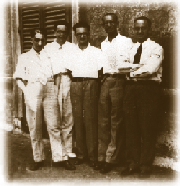
Physics Department of Rome University located in Via Panisperna a group of young Italian
scientists worked relentlessly to discover nuclear energy. They were called "I
ragazzi di Via Panisperna" (the boys of Via Panisperna). They were Enrico Fermi
(Nobel price in Physics), Edoardo Amaldi, Emilio Segre' (Nobel Price in Physics),
D'Agostino, Bruno Pontecorvo, Ettore Majorana, and others. The director and organizer of
the Department was the protective although patronizing Orso Mario Corbino (nicknamed
"the almighty").
"I ragazzi di Via Panisperna" (right)
|
|
|
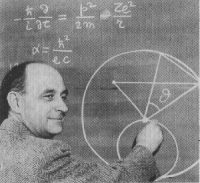
Enrico Fermi
was born in Rome in 1901, his father was a manager of the Italian railways. He was
attracted by Physics after reading a 15th century Physics book found in a stall of a
popular market in Rome. When he passed the admission examination at the Physics University
in Pisa (19 y.o.), the Professors were surprised of his answers and had to ask him to
explain his theories. At the University, instead of learning, he often taught, replacing
the teachers. At 25 y.o. he was already a University Professor, of a new chair prepared
for him: Atomic Physics. |
In the experiments in the department in Via Panisperna, organized with very simple, often
self-made laboratory tools and materials, Fermi and the "boys" discovered how to
bombard heavy metals with nuclear particles. The bombardment lead to the fragmentation of
nucleuses and hence to the discovery of new heavy metals, to the generation of nuclear
energy, and also potentially to chain reactions (i.e. particles of the bombarded nucleus
would then do the same with neighbouring nucleuses). |
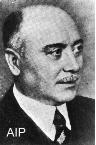
Orso Mario Corbino (Director). |
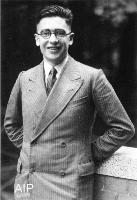
Emilio Segre |
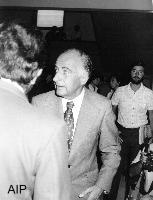
Bruno Pontecorvo |
Initially, the aim of such
researches was entirely peaceful, and was to find new therapies to eradicate cancers. All
their discoveries were in fact licensed as therapeutical measures.
Unfortunately, Fermi experienced the discrimination
against the Jews, which led to the 1938 Racial Laws of the Italian Fascist state. Fermi
was not a Jew, but his wife was. Moreover, his protectors, Guglielmo Marconi and the
director of the Physics Institute died. So in 1938, after having personally received the
Nober Price in Sweden, he did not return to Italy, going straight to Chicago. He began
teaching at the University of Columbia in New York. With his theories, and following also
the suggestion of Leo Szilard (Hungarian), he discovered the chain reaction of
nuclear energy.
He took part of the "Manhattan" project to build a nuclear
bomb, under the command of Gen. Groves, and whose premises were at Los Alamos. The project
was kept utmost secret, to the point that the locations with the plants were removed from
maps, and that also vice-president Truman, once he came into office, knew nothing of the
project.
Szilard tried to convince the others scientists and the US government not to use the bomb
because of its devastating effects. |
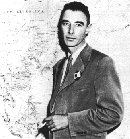
Robert Oppenheimer |
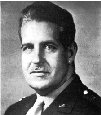 Gen. Groves |
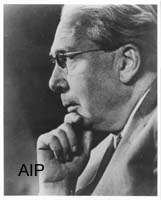
Szilard |
|
 Enrico Fermi and the "Panisperna boys"